Reggio Calabria, 1 – 4 October 2025
The Mob in Med! meeting has just concluded in Reggio Calabria. Consisting in an awareness campaign on youth mobility in the Mediterranean, the project is led by Réseau Euromed France (REF) and Jeunesses Med – Med Youth Network, in collaboration with Mana Chuma Teatro.
19 activists from Algeria, Jordan, Lebanon, Libya, Palestine, Tunisia, Italy, France, and Spain took part in a series of meetings and workshops aimed at developing sustainable and inclusive strategies to address the growing challenges to mobility across the region.
Advocacy workshops, debates and exchanges with Institutions
The first day kicked off on the terrace of the Medinblu Hotel with an introductory session that allowed the group to meet in person after months of online workshops, during which the editorial line, communication plan and advocacy for the project were defined.
In the afternoon, the Spazio Open bookshop hosted a meeting with the municipal councillor for education, universities and equal opportunities, Anna Maria Briante, to whom the campaign was presented. Briante showed sincere interest in the initiative, declaring her intention to acquire new ideas useful to the Calabrian capital, where the urban mobility plan does not always meet the needs of young people living in more peripheral areas and small provincial towns.
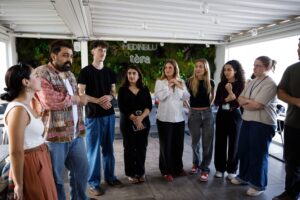
The following day, again at Spazio Open, Domenico Marino, professor of economic policy at the Mediterranean University of Reggio Calabria and member of the ‘No Ponte’ movement, spoke about the characteristics and critical issues of the complex engineering project that would connect the cities of Reggio Calabria and Messina. Analysing its feasibility and sustainability, Marino highlighted the economic, social and environmental impact that the infrastructure would have on the territory and local populations, who are completely excluded from a purely political decision-making process that does not take their needs into account. In both Calabria and Sicily, the road networks are still inadequate, public transport services are inefficient and the railway lines are so underdeveloped that those living in inland areas are condemned to forced isolation.
Some participants noted that even in their own countries, the millions invested by governments rarely reflect the real needs of the people, either because they have little impact on their quality of life or because they remain unpractical and inaccessible. The role of civil society in raising awareness of these issues was also emphasised.
Finally, the intervention by young people from Reggio Calabria shifted the focus to the growing involvement of the younger generation in local public debate, as demonstrated by the recent protests against the ongoing genocide in Gaza. In fact, more and more people are returning to live in the South after completing their studies or thanks to the now widespread practice of smart working, in order to contribute to its change with new skills and perspectives.
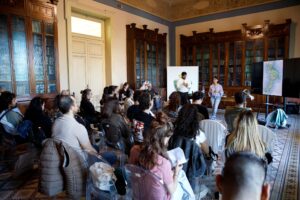
In the afternoon, Palazzo Alvaro, the headquarters of the Metropolitan City, hosted advocacy workshops on local and regional mobility. The young people discussed key aspects of the transport system in their different countries of origin, identifying specific features and common elements, with the aim of promoting more connected, equitable and sustainable mobility in the Euro-Mediterranean region through specific recommendations. Two important aspects that emerged during the session were safety, which mainly concerns women and their use of transport at night, in rural areas of North Africa as well as in the large Parisian banlieues, and architectural barriers that limit accessibility for people with disabilities, preventing mobility from being fully inclusive.
Lastly, the possibility of creating shared transnational regulations to facilitate agreements between different governments and ensure easier and legal travel within the “Med Space” was discussed.
Towards new perspectives
On the morning of 4 October, a lively brainstorming session was held at the Spazio Open bookshop, focusing on the most effective and innovative ways to communicate the campaign’s content, including through digital tools and participatory approaches. A number of organisations involved in the issue of mobility in the Mediterranean, local networks and independent media were identified to ensure greater visibility for the project and to raise awareness among the public and institutions on the issues addressed.
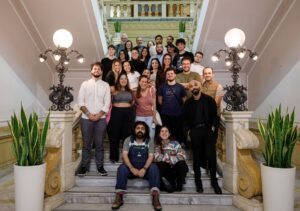
The event concluded with an afternoon meeting at Palazzo Alvaro with Serena Franco, from Eurocoop Camini’s “Jungi Mundu” project, Haseeb Bukhari and Shajib Mattuber, two cultural and linguistic mediators involved in the initiative. Their testimonies allowed the activists of Mob in Med! to learn about a virtuous model of reception and integration that has enabled a small community at risk of extinction to be reborn thanks to the contribution of asylum seekers, political refugees and migrants and the direct involvement of citizens.
The discussion gave rise to an in-depth dialogue on the issues of inclusion and territorial development and on the importance of addressing the phenomenon with a shared and participatory approach.
Over the coming months, the working group will integrate the recommendations with the content discussed during these days of intense live debate.
Finally, four videos filmed by participants in the Parisian suburb of Seine-Saint-Denis, Calabria, Lebanon and Palestine will be completed with the mentoring of director Felice d’Agostino, along with an illustrated booklet by French-Egyptian artist Tiana Kader on the travel stories of 10 participants of the Med Youth Meeting, organised in Reggio Calabria by the same associations in 2024. The publication, in French and English, aims to reflect on the difficulties and challenges they encountered in reaching southern Italy, a symbolic as well as geographical location where chronic infrastructure shortages and scarce job opportunities still drive thousands of young people to emigrate, as in every other “South” of the world.
Photos: Marco Costantino
Media partners: Etimologia Magazine; Quotidiano del Sud; Babelmed.